
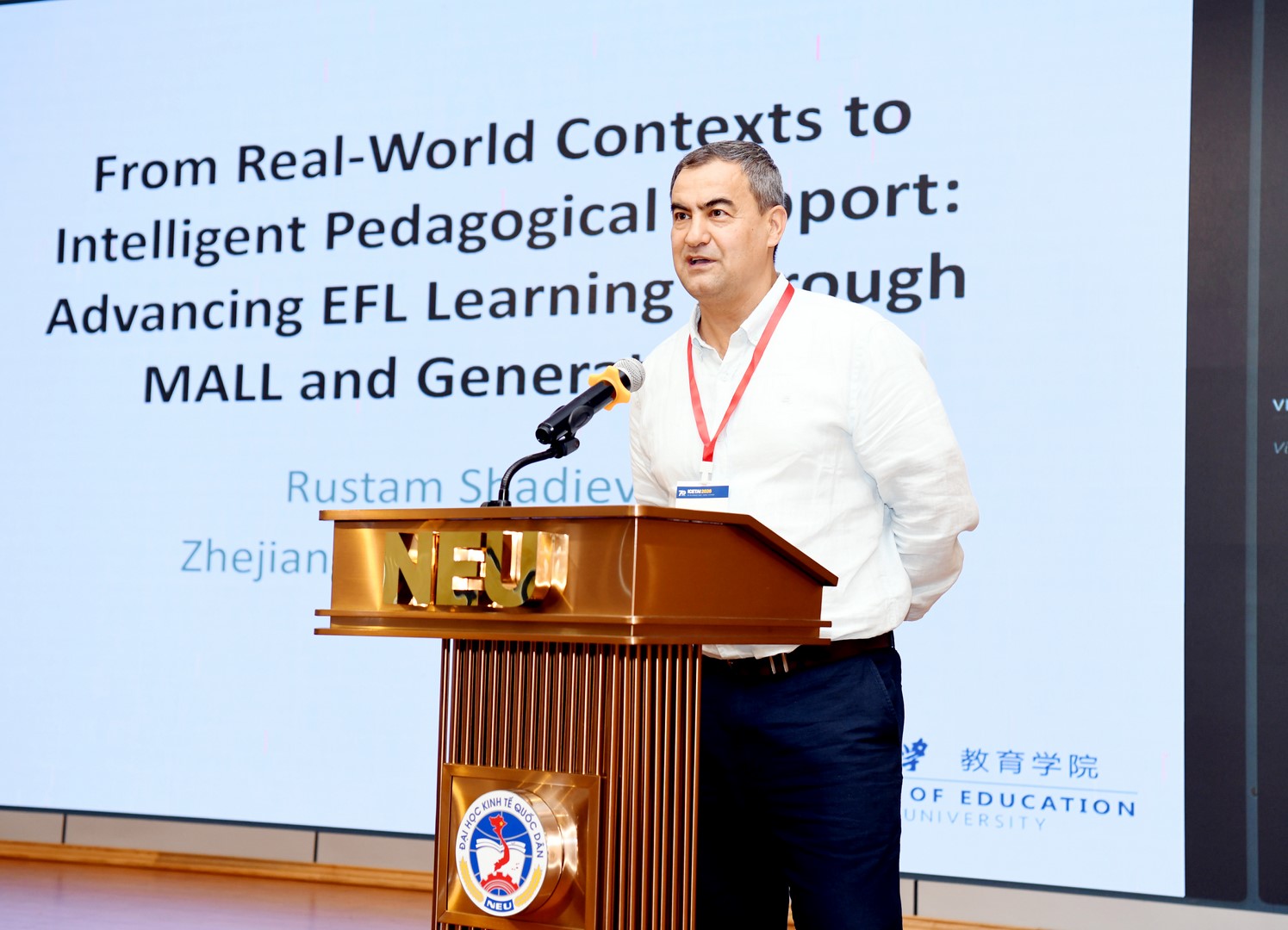

Prof. Shadiev Rustam
College of Education, Zhejiang University, China
Opening the keynote program at ICETAI 2026, Prof. Shadiev Rustam presented "Enhancing EFL Learning Across Familiar and Unfamiliar Contexts Through Mobile Learning and Generative AI." He began from a simple observation: mobile technology is now woven into daily life for adults and children alike, and his research treats that fact as an opportunity rather than a distraction — a way to connect what students learn in the classroom to the world they live in outside it.
From the textbook to the supermarket
He illustrated the idea with a lesson built around the theme of "the market." In a traditional classroom, students learn vocabulary, currency, and dialogue for buying and selling. Taught only from a textbook, he argued, this knowledge stays abstract and disconnected from real life. His approach instead sends students to an actual convenience store or supermarket afterward, where they name items, role-play a purchase, and handle change — practicing the same language in the authentic setting it was meant for.
Why "familiar" matters
Stepping outside the classroom raises a further distinction: the real-world setting can be familiar or unfamiliar to the learner. Prof. Shadiev used his own first visit to the National Economics University as an example — an authentic setting, but one where he had no existing mental map of the building or the campus. He linked this to cultural schema theory: repeated exposure to a place builds a mental schema of it, and that schema is what eventually makes an unfamiliar environment familiar.
To test whether this distinction actually affects learning outcomes, his team — at Nanjing Normal University — ran a study with 50 university students: a control group of 25 completing an EFL course through five tasks (environmental issues, healthy lifestyle, transportation, dining experiences, and iconic places) in unfamiliar environments, and an experimental group of 25 completing the same five tasks in familiar ones. Both groups used a mobile learning app called "Daily English," combining a textbook, the tasks themselves, a dictionary, a communication tool for peer sharing, and a "learning map" showing where on campus each student had created their content.
On the post-test — an 18-item College English Test covering translation and essay writing — the familiar-environment group scored significantly higher (M = 78.71 vs. 74.72, F = 4.802, p = .033). Their writing tasks also scored higher across every one of the five tasks and every dimension measured — amount, content, organization, creativity, grammar, and vocabulary. Interviews with 10 students from each group pointed to why: the familiar-environment group reported stronger interest, enjoyment, and confidence, while several unfamiliar-environment students described the setting itself as the obstacle — one recalled having to complete a task in an unfamiliar cafeteria, where the unfamiliarity "significantly dampened my enthusiasm."
From generative AI to pedagogical agents
The second half of the talk turned to generative AI, which Prof. Shadiev described as having become as ordinary a tool for translation and search as a phone itself — he recounted a waiter in Hanoi reaching for ChatGPT mid-conversation to answer a question about Vietnamese egg coffee. But used as a plain chat tool, he argued, generative AI produces passive learning, reduced reflection, and surface-level interaction. His research instead builds "pedagogical agents" that guide a learner through five stages — plan, draft, review, revise, reflect — with the agent (in his example, one named "Emmy") checking the learner's plan, giving actionable feedback, and coaching revisions at each step. As he summarized it: the pedagogical value of such an agent is not simply better output, but better participation in planning, drafting, revising, and reflecting. He showed how such an agent can be configured inside a tool like ChatGPT by defining its aim, expected behavior, and the kind of feedback it should give.
Applied back to unfamiliar environments, a pedagogical agent can support a learner before a visit (helping them research the place, as he did before arriving at NEU), during it (guiding observation and questions), and after it (supporting reflection and follow-up work) — a way to make even an unfamiliar setting usable for learning, not just a familiar one.
Recommendations
Prof. Shadiev closed with practical guidance for educators: start activities in the classroom and extend them outward; design for familiar contexts where possible; and when the setting must be unfamiliar, use deliberate familiarization strategies and pedagogical agents to bridge the gap. He noted the study's limitations — a sample of 50 students and short task durations — as directions for future work.