
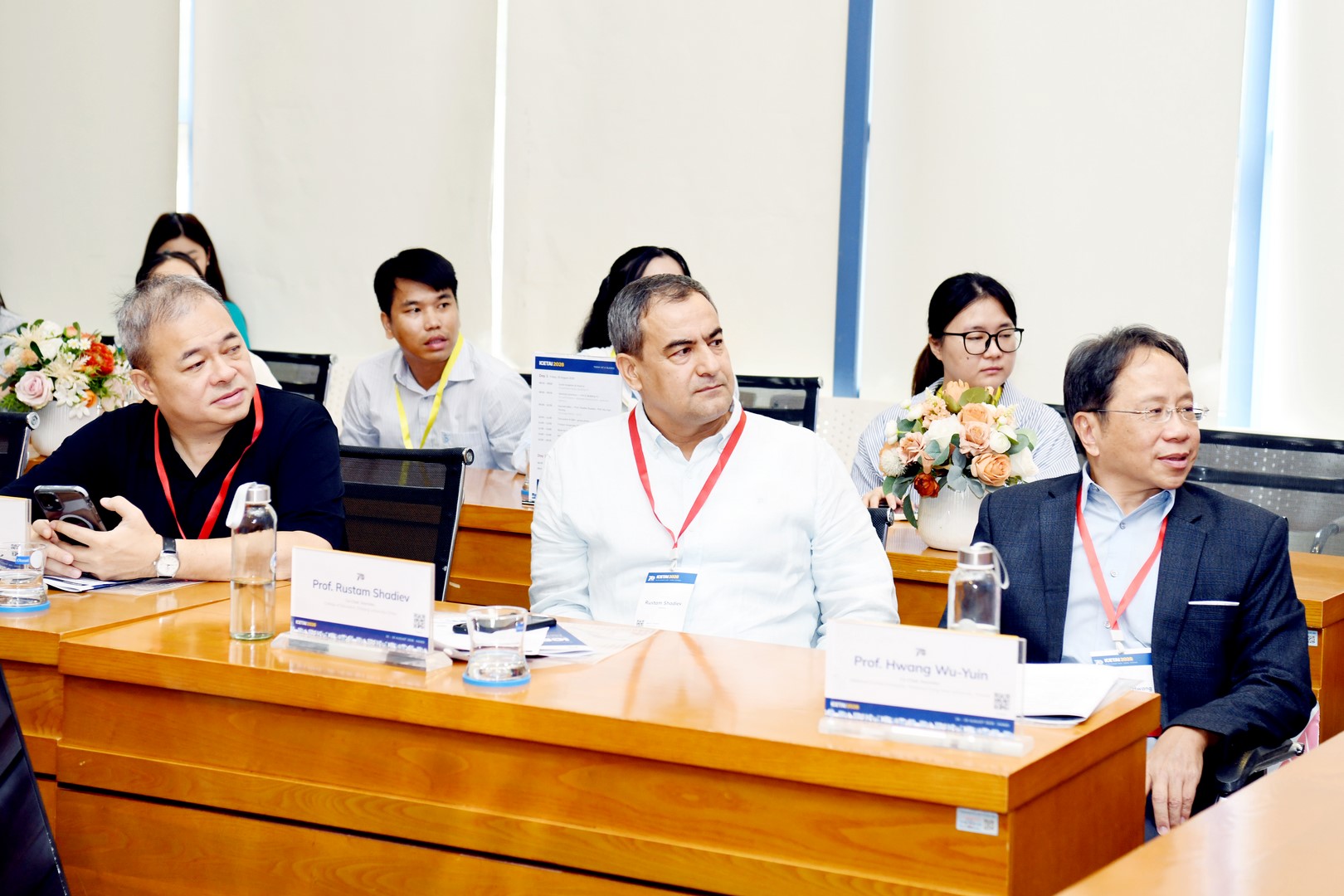
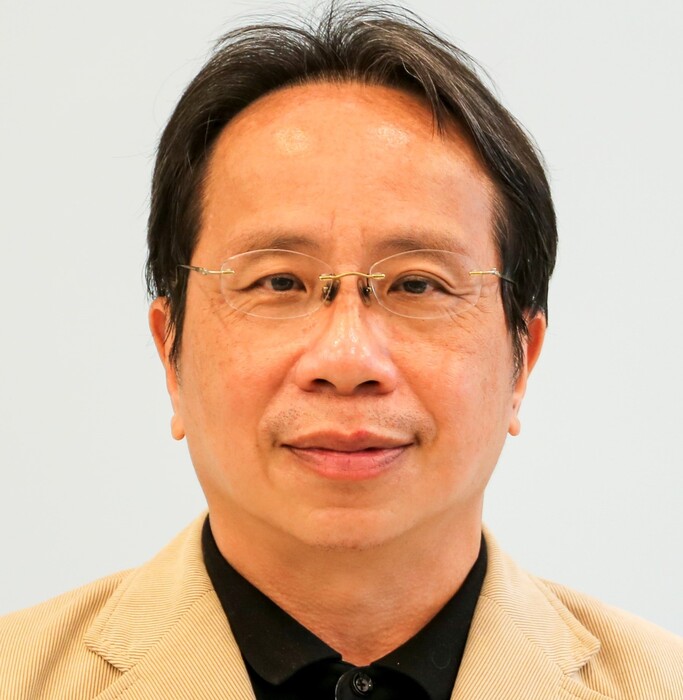
Prof. Wu-Yuin Hwang
Distinguished Professor, National Central University, Taiwan
Prof. Wu-Yuin Hwang opened the second keynote of ICETAI 2026 by naming a concept he said the audience was likely hearing for the first time: "Eternal Learning" — learning that continues not just for a lifetime, like sustainable or lifelong learning, but after a person dies, carried on by an AI trained closely enough on their own thinking to continue in their place. The talk drew on his paper "Eternality in Learning: A Three-Stage Conceptual Framework for the Evolution of Generative AI to Influence Human Learning," published in IEEE Access in 2026.
The framework is built as a narrative literature review — surveying published generative-AI-in-education research from 2022 to 2026 and organizing it into three evolutionary stages, analyzed across five "AI agency" dimensions: autonomy level, memory persistence, interaction role, learning continuity, and how much control stays with the human. It is explicitly aligned with UNESCO's AI competency frameworks for teachers (AI-CFT) and students (AI-CFS), both of which describe competence progressing through similar stages — acquire, deepen, create for teachers; understand, apply, create for students.
Stage one: smart tools
At this stage AI remains fully controlled by the human and responds reactively, but it is already personalized and context-aware, working through three mechanisms: memory extension (retrieving and summarizing information faster than a person could), authentic interaction (connecting classroom knowledge to the physical world), and contextualized feedback (adapting to an individual learner's level). Prof. Hwang illustrated this with published examples: Smart RoamLingo, which turns a photo into vocabulary and AI-generated example sentences for EFL learners, and Geo-QG, which uses augmented reality to generate geometry word problems from the measurements of real objects around a student.
Stage two: learning partners
The second stage shifts AI from a one-way tool into a co-creative collaborator: agentic memory that persists and reflects across sessions, contextual retrieval that gathers multimodal data proactively rather than waiting for a prompt, and co-creative problem-solving shared between human and AI. His central example was XoT ("Education of Things"), his own published study in which students converse in English with AI-powered smart objects — a smart air purifier, a smart display — with each exchange instantly shared across the whole device network. The connected objects built knowledge bases four times richer than unconnected control objects, alongside a measurable improvement in students' EFL writing.
Stage three: cognitive clones
The final stage, which Prof. Hwang described as the theoretical peak of the framework — partly conceptual, and not yet fully validated — distinguishes a cognitive clone from a simpler "digital twin." A digital twin replicates what a person currently knows; a cognitive clone goes further, approximating how they reason and make decisions, and continuing to evolve after they are no longer present to guide it. He grounded the idea in two of his own published studies: ELMTS, where a trained model's correctness, relevance, completeness, and clarity scores each improved substantially against a baseline, and a larger pilot with 40 student participants that reached F1 scores above 0.70 across trials. As one illustration, he described a "Mind Shadow" that could tell a learner, in their own reasoning style, "you usually miss this data point" — and, more speculatively, a version that could keep applying a late scientist's own theories to new data after their death.
A threshold, not a target
Prof. Hwang was careful to frame Stage 3 as a threshold to watch rather than a goal to build toward — flagging cognitive offloading and the erosion of human agency as real risks, and calling for "digital inheritance" rights and ethical anchoring mechanisms to keep a cognitive clone from drifting away from the person it was trained to represent. For teachers and students, his practical recommendation was to shift curricula from knowledge acquisition toward what he called cognitive calibration: training and auditing one's own thinking patterns, not just recalling content.